
Since the tenth annual Scientiae Conference, that was supposed to take place at McGill University, Montreal, Canada, 1–4 June 2022, has been cancelled, we have organised an exciting series of events for the Summer of 2022. On Friday 3 June and Friday 10 June, we will get together to discuss Transformative Empiricisms and European Knowledge-Making in the New Worlds.
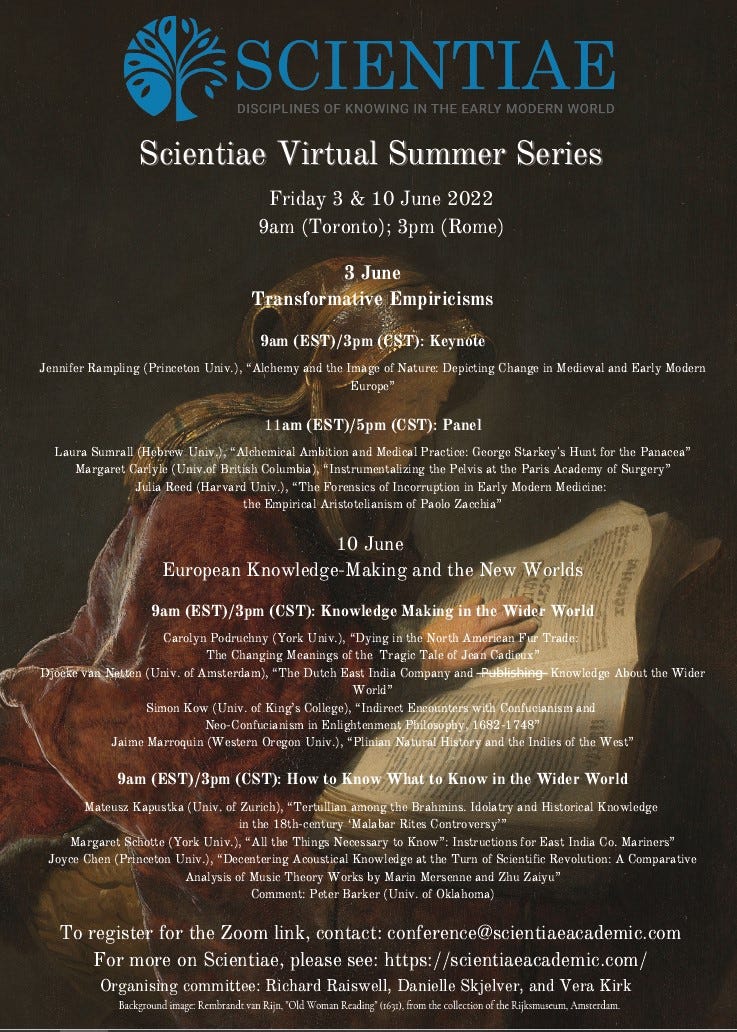
All sessions are free. But we ask that you register for the Zoom link at the email address:
conference@scientiaeacademic.com.
The programme (with abstracts) for this event can be downloaded here.
We look forward to seeing you!
The Organising Committee: Richard Raiswell, Danielle Skjelver, and Vera Kirk.
Programme
Scientiae is delighted to announce the schedule for its summer virtual seminar series. The organising committee has put together three two-session days, each dealing with different problems in the pre-modern knowledge formation from different perspectives.
Please disseminate widely.
Friday 3 June 2022: Transformative Empiricisms
9AM (EDT) / 3PM (CET): Keynote Talk
Jennifer Rampling (Princeton), “Alchemy and the Image of Nature: Depicting Change in Medieval and Early Modern Europe”
11AM (EDT) / 5PM (CET): Panel
Laura Sumrall (Hebrew Univ.), “Alchemical Ambition and Medical Practice: George Starkey’s Hunt for the Panacea”
Early modern alchemical physicians like Jan Baptista van Helmont (d.1644) spent vast amounts of time, effort, and resources in the pursuit of seemingly unobtainable goals. For instance, George Starkey (d.1665), an English Helmontian, spent decades of his life in pursuit of the alkahest, a substance thought to be capable of perfected purification. As an alchemical physician, Starkey’s alchemical ambitions were also medical ones. Thus the ambition to achieve perfected purification became the ambition to develop a perfected cure — a universal medicine. Both could be judged unobtainable. However, by considering these ambitions in light of the Helmontian disease theory that justified them, it becomes clear that the pursuit of universal medicine was not only a rational ambition — it also transformed medical practice without ever entering medical practice.
Julia Reed (Harvard Univ.), “The Forensics of Incorruption in Early Modern Medicine: the Empirical Aristotelianism of Paolo Zacchia”
The oft-cited father of forensic medicine, the seventeenth-century papal physician Paolo Zacchia, defended the superior expertise of the medical professional who, by “incessantly pursu[ing] the works of nature,” was able to discern what “deviates” from the normal operations of nature and what exceeds its operations. In this paper, I offer a close reading of Book IV, Question 10 of Zacchia’s masterwork, Quaestiones medico-legales, on the determination of incorruptible cadavers, and specifically Zacchia’s guidance in discerning the miracle of supernatural preservation. According to Zacchia, the physician had to eliminate all the natural operations that might delay corruption, ranging from embalming to individual temperament, history, and cause of death. I will argue that Zacchia’s definition of incorruption was a crucial moment in the “empirical Aristotelianism” of the commentary tradition on the fourth book of Aristotle’s Meteorology, which was associated with alchemy an “alternative” Aristotelianism since the Latin translations of Aristotle in the twelfth century. In the mid-sixteenth century, commentaries on Meteorology 4 increasingly read it as medical text that could unite Aristotelian philosophy’s investigation of causes with practical medicine. Drawing on the work of William Newman, Craig Martin, and Gianna Pomata, I will focus on Zacchia’s reading of Meteorology 4 and show that Zacchia builds on this particular commentary tradition and champions the physician as the supreme natural philosopher and observer of nature. Since the physician was uniquely capable of judging material signs on and in bodies, they became indispensable to the work of distinguishing natural from supernatural events.
Margaret Carlyle (Univ. of British Columbia), “Instrumentalizing the Pelvis at the Paris Academy of Surgery”
The maternal pelvis is an important site in visual traditions of eighteenth-century childbirth practice. Birthing manuals are full of illustrations of disembodied bony pelvises that obstruct the “natural” course of childbirth. In light of the increasing attention paid to so-called problematic pelvises, practitioners increasingly sought to establish “normal” ones while using measurements as a means to diagnose a too-narrow or otherwise aberrant pelvis. New instrumentation abounded to construct this burgeoning science of pelvimetry, including an instrument dubbed the pelvimeter, which was designed to ascertain the girth of the pelvic passageway with delivery outcomes in mind. Would it be a manual or instrumental delivery, or would a risky Caesarean operation be required?
Friday 10 June: European Knowledge-Making in the New Worlds
9AM (EDT) / 3PM (CET): Plenary Panel, “Knowledge Making in the Wider World”
Carolyn Podruchny (York Univ.), “Dying in the North American Fur Trade: The Changing Meanings of the Tragic Tale of Jean Cadieux”
French Canadian voyageurs, who worked as porters traversing thousands of miles along rivers and the lakes in the North American fur trade, developed a distinct occupation shaped in large part by the environment and conditions of their workplace. As nonliterate peasants from the small colony in the St. Lawrence River Valley, they brought with them the tradition of creating stories to develop, preserve, and disseminate knowledge. Among the most robust and long-lasting stories was the tale of Jean Cadieux, who lost his life while hiding from Indigenous foes attacking his brigade for their cargo. The story became attached to one particular location along the Ottawa River, but it changed over time to reflect developments in voyageurs’ working culture. In its infancy at the start of the 18thcentury, the tale depicts Cadieux as a hapless victim unable to help his crew. At the height of its popularity in the late 19thcentury, Cadieux had transformed into a family man bravely sacrificing his life for his Indigenous family. In all instances the Virgin Mary makes an appearance to save the lucky ones running through rapids and Cadieux miraculously develops the ability to write a death song, which he carves onto a tree.
Djoeke van Netten (Amsterdam Univ.), “The Dutch East India Company and Publishing Knowledge about the Wider World”
The establishment of the Dutch East India Company (VOC) in 1602 marked several changes in the relation between the Dutch and the Wider World. One of them was the sudden stop in printed works about Asia, that would only recommence after the mid 17thcentury. This talk sets out to explore and explain this period of (not always successful) secret keeping. I will do so by discussing the books that actually were printed, while keeping an eye on what was not published. Thus, we can reconsider the often presented view of the Dutch Republic as the tolerant open ‘bookshop of the world’.
Simon Kow (Univ. of King’s College), “Indirect Encounters with Confucianism and neo-Confucianism in Enlightenment Philosophy, 1682–1748”
European Enlightenment encounters with Confucianism and neo-Confucianism are commonly regarded as unoriginal caricatures of Chinese thought which draw selectively especially from Jesuit missionary accounts to bolster Eurocentric agendas. While there is no evidence of specific Chinese influence on Enlightenment philosophy, and encounters with Chinese thought are indeed indirect — filtered through the China Jesuits and other travellers — I argue that Confucianism and neo-Confucianism as understood by such early Enlightenment thinkers as Pierre Bayle, Gottfried Wilhelm Leibniz, and Charles de Montesquieu were interpreted in divergent and fascinating ways which reveal key aspects of their thought. In other words, while Enlightenment views of Confucianism and neo-Confucianism do not really add to our knowledge of China in this period, they do disclose various and competing attempts at globalising the Enlightenment which in turn influenced subsequent Enlightenment thought on China and even modern Chinese engagements with western thought and culture. I conclude by calling for a reconsideration of Bayle’s cross-cultural scepticism against Leibnizian and especially Montesquieuian (and post-Montesquieuian) approaches to China.
Jaime Marroquin (Western Oregon Univ.), “Plinian Natural History and the Indies of the West”
This presentation argues that naturalists of the Indies followed and preserved the universalist model of natural history developed by Pliny the Elder in service of imperial Rome. While Renaissance European natural history would gradually become more specialized in its identification and description of animal and plant species, in the Indies, natural historians retained the encyclopedic design of Pliny’s Naturalis Historia. Interestingly, the universalism of the natural histories of authors such as Gonzalo Fernández de Oviedo, José de Acosta and Bernabé Cobo, developed an experience-based historiographical model for a comparative study of local environments and nations. Humboldt himself recognized that his concept of a ‘global physics’ was in many ways a continuation of ideas developed in natural histories from the Indies of the West. These works were all composed through a polyphonic gathering and translation of fundamentally oral sources through the ever-expanding colonial administrative, religious, and medicinal networks.
11AM (EDT) / 5PM (CET): Panel, “How to Know What to Know in the Wider World”
Mateusz Kapustka (Zurich), “Tertullian among the Brahmins. Idolatry and historical Knowledge in the 18th-century ‘Malabar Rites Controversy’”
In 1703, Charles-Thomas Maillard de Tournon, Patriarch of Syrian Antioch and papal legate, was sent by Clement XI to Pondicherry in the South Indian province of Tamil Nadu in order to examine the missionary practices of the Jesuits. These were accused of tolerating idolatry and practicing cultural accommodation to benefit from the acknowledgement from the side of the Hindu highest brahmin caste. This case was for both Catholics and Protestants a negative historical exponent of how the ancient culture of idolatry can be preserved through imitation. The paper investigates this spectacular conflict from the perspective of the transcultural history of images and the historical critique of visual discourses. After a long interrogation of the case, in 1728, a 400-pages elaboration in Italian of Tournon’s decree (Esame e difesa del decreto pubblicato in Pudisceri da Monsignor Carlo Tommaso di Tournon) was published in the Vatican. In this document, devoted to a great extent to the issue of iconic rituals of the Hindu society and focused in this respect on the idol Pulleyar (Ganesha) from Malabar (Kerala) in South India and on the ‘idolatrous’ origins of the tilaka (Hindu marks on the forehead), the major arguments were taken from the early Christian apologetics. Tertullian was called as the original and topical authority in the casus of idolatry, with quotations from his De idololatria, De spectaculis, and De cultu feminarum. The paper investigates how these were adapted both for the Catholic condemnation of Hindu religious practices and for the further dissemination of the ancient Syrian-Malabarian rite of the local converts, called after the first Christian martyr of India ‘Thomas Christians’. Accordingly, the focus will also be set on how that controversy included an anachronistic categorization of different kinds of Antiquity and whether historical knowledge was used to put the ‘pagan’ Antiquity again to a historical trial with means of ‘early Christian’ conversion.
Margaret Schotte (York Univ.), “All the things necessary to know”: Instructions for East India Co. Mariners”
When European merchant companies sent their fleets eastward to Asia in the 17th and 18th centuries, they made uneven efforts to prepare their employees. In addition to the charts and instructions on board each vessel, some of the crew received written navigation instructions, others foreign-language glossaries and lists of popular trade goods in India and China. Drawing upon archival records, this paper will compare the technical and geographical information provided by the Dutch, English, and French companies, shedding light on the background knowledge that each company expected their employees to have. The cursory nature of the geographic and meteorological information is of particular interest, since it suggests that the companies relied to a considerable extent on the personal experience of crew returning to the same region more than once. By comparing the records of several companies, this research opens a window into colonial knowledge-making on an individual as well as transnational level.
Joyce Chen, (Princeton), “Decentering Acoustical Knowledge at the Turn of Scientific Revolution: A Comparative Analysis of Music Theory Works by Marin Mersenne and Zhu Zaiyu”
Regarded as the father of modern acoustics, Marin Mersenne, in his Harmonie Universelle (1636), compiled not only a comprehensive collection of musical instruments but also included an in-depth exploration of sound and music theory using mathematics, geometrical representation, and Galilean theory of mechanics. Mersenne’s work demonstrates an epistemic shift of rising empiricism in natural philosophy, particularly with the presence of (imaginative) musical instruments. Music theorist Alex Rehding shows that, in addition to music-making and experiential purposes, musical instruments can be used for scientific-epistemic experiments, as seen in the works of Pythagoras and Nicola Vicentino. In one of the most significant explorations of modern acoustics, Mersenne uses plucked instruments to develop an accurate formula for the vibrating string and reconceptualizes a 31-note keyboard for various tuning preferences.
But what happens to our notions about early modern acoustics if we consider that the first correct equal temperament calculation came from Ming Dynasty (1583)? There is indirect evidence suggesting the acoustical knowledge may have been transmitted to the West. This paper will address the implication of this recent finding. I will first translate and elaborate the theoretical works of Zhu Zaiyu 朱載堉 and how he accurately obtained the mathematical description of equal temperament by experimenting with various types and lengths of bamboo pipes. Musicologist Gene Cho suggests that Jesuit missionary Matteo Ricci transmitted Zhu’s publications to the West at the beginning of seventeenth century. By looking at these two cases comparatively, I will argue that empirical approach towards acoustics — and ‘science’ at large — is not and should not be a western-centric notion, but rather, a cross-cultural phenomenon.
 Scientiae